
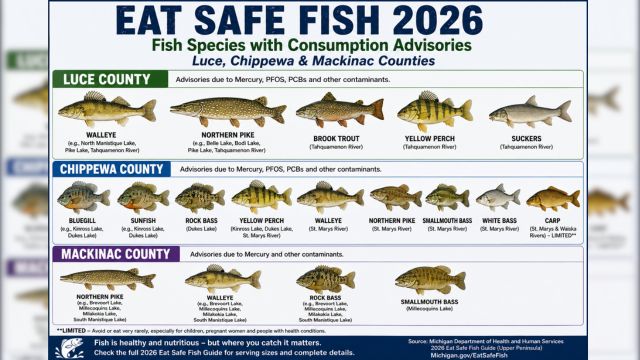
Anglers across the Eastern Upper Peninsula are being encouraged to review updated fish consumption recommendations after the Michigan Department of Health and Human Services released its 2026 Eat Safe Fish Guide.
The guide provides recommendations on how often fish from specific lakes and rivers can be safely eaten based on testing for contaminants such as mercury, PFOS, PCBs and dioxins.
In Luce County, many of the advisories focus on larger predatory fish. Northern pike from several waters, including Belle Lake and Bodi Lake, are limited to one or two meals per month depending on size. Walleye from North Manistique Lake, Pike Lake and portions of the Tahquamenon River are also subject to consumption limits because of mercury contamination.
The Tahquamenon River, one of the region’s most popular fishing destinations, carries advisories for brook trout, northern pike, suckers, walleye and yellow perch. Larger northern pike are among the most restricted fish, with recommendations dropping to as little as six meals per year in some cases.
Chippewa County includes some of the most significant advisories in the Eastern Upper Peninsula. Kinross Lake and Dukes Lake contain PFOS related warnings for several popular panfish species. At Kinross Lake, bluegill and sunfish are listed as “Do Not Eat,” while yellow perch are limited to six meals per year. Dukes Lake also carries “Do Not Eat” advisories for bluegill, rock bass and sunfish.
The St. Marys River remains a productive fishery, but several species have consumption recommendations tied to mercury, PFOS or PCB contamination. Walleye, northern pike, bass, white bass and yellow perch all carry meal limits based on fish size. Carp from the St. Marys and Waiska rivers are listed as “Limited,” meaning they should generally be avoided by children, pregnant women and people with certain health conditions.
In Mackinac County, mercury continues to drive most consumption advisories. Waters including Brevoort Lake, Millecoquins Lake, Milakokia Lake and South Manistique Lake all have restrictions on northern pike, walleye and rock bass. Most advisories range from one to four meals per month, depending on species and size.
The guide emphasizes that fish remains a healthy source of protein and nutrients, but consumers should follow recommended serving limits to reduce exposure to contaminants that can accumulate in the body over time.
MDHHS notes that no amount of fish listed under a “Do Not Eat” advisory should be consumed. The agency also recommends cleaning fish properly, removing skin and fatty tissue when appropriate, and grilling or broiling fish to reduce exposure to some contaminants.
For lakes, rivers or fish species not specifically listed, anglers should refer to the statewide consumption guidelines included in the guide. The complete 2026 Eat Safe Fish Guide is available through the Michigan Department of Health and Human Services.