
By Heather Johnson Durocher
Michigan Department of Natural Resources
For some visitors to Tahquamenon Falls State Park, the main attraction at Michigan’s second-largest state park had always remained out of reach.
For those using wheelchairs, experiencing the iconic, 200-foot-wide, amber-hued Upper Falls up close was impossible. A 94-step staircase stood in the way, leading to a viewing platform near the brink.
“We heard time and time again from people that because of accessibility, they had never been to the brink, had never been able to feel that spray hit their face or smell the river,” said Kevin Dennis, park manager at Tahquamenon Falls State Park.
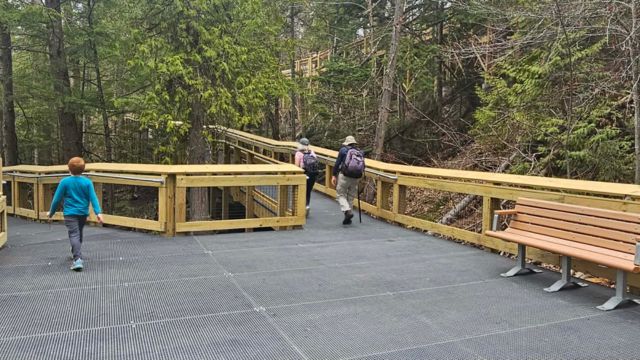
That has now changed with the official opening of a new 1,100-foot, fully accessible boardwalk, replacing the aging staircase. The new feature offers all visitors close-up, panoramic views of the Tahquamenon River as it rushes over the edge and drops about 50 feet.
“It’s really exciting to be able to open it to the public,” Dennis said. “The public has been so patient during these past few years of hard work by a lot of people to bring this project to life. It feels great to see it finished, and most importantly, it feels good to watch as people use the new boardwalk.”
Michigan Department of Natural Resources Director Scott Bowen joined staff and community members at a ribbon-cutting ceremony celebrating the new accessway.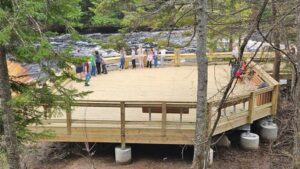
“Access to public lands for everyone is a priority for the Michigan Department of Natural Resources, and Tahquamenon Falls is a prime example,” Bowen said. “Today, we celebrate the opening of this beautiful boardwalk, the latest feature furthering our legacy of partnership, collaboration and public access across our state.”
The boardwalk marks the latest effort to improve accessibility at the park. With the Lower Falls boardwalk extension and island bridge project completed in 2021, both the Upper and Lower Falls are now fully accessible.
“We’re here to celebrate one of our signature state park projects that demonstrates our mission — preserving natural resources while also providing access to recreation,” said Kristen Kosick, chief of the DNR Parks and Recreation Division.
The new boardwalk winds through old-growth forest, featuring five switchback landings with interpretive displays, benches and new vantage points of the river and falls. While the route may take up to 30 minutes longer than the former staircase, the journey is significantly easier. Visitors may also use available wheelchairs or track chairs.
For Missy Davert, 62, the new access brought an emotional return.
“I was here as a little girl,” said Davert, who uses a wheelchair. “My dad had me in a backpack on his back.”
She hadn’t been back to the brink in 50 years.
“I thought I’d never come back down here again,” she said. “This is one of my most favorite places in the world. This feels like heaven. I’m just so grateful. There are no words.”
Davert and her husband, Ken, were among several wheelchair users who attended the ribbon-cutting and experienced the boardwalk for the first time.
Bryan Wilkinson, co-chairman of the DNR’s Accessibility Advisory Council, also spoke at the ceremony.
“Accessibility is super important, and I hope the DNR continues to keep this drumbeat going,” he said. “I look forward to the hundreds of thousands, the millions of people who are going to get to experience this.”
The approximately $1.6 million project was completed in partnership with OHM Advisors and ASI Environmental. Construction posed unique challenges, including navigating a steep, forested slope with more than 60 feet of elevation change. No machinery was allowed on the slope during construction.
Funding included $70,000 in DNR capital outlay dollars and more than $1.5 million in federal relief funding through Gov. Gretchen Whitmer’s Building Michigan Together Plan.