
By Sterling McGinn
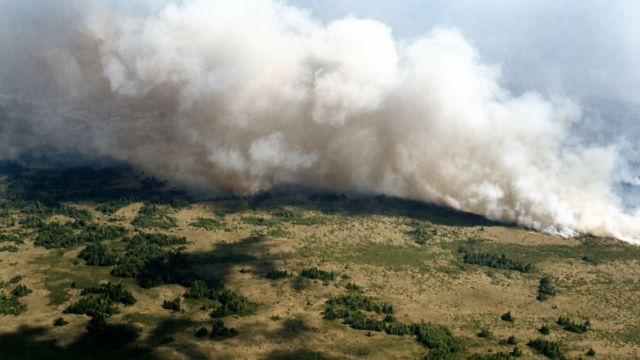
A lightning strike on dry, old vegetation in the summer of 1976 started a wildfire that destroyed 72,000 acres in and around the Seney National Wildlife Refuge.
The Seney Fire, or Walsh Ditch Fire, was first discovered on August 1, 1976, by a DNR contract fire patrol plane. More than 1,000 men and woman from all over the Unites States—both with state and Federal agencies—worked to fight the fire over the next few months.
It was the most destructive and costly fire in Michigan since 1908. The estimated cost to put out the fire was $8 million.
The fateful bolt of lightning hit on July 30 during a very dry summer. Rainfall was six to eight inches below normal. In the Seney National Wildlife Refuge, old vegetation, muck, and peat had been were exposed after refuge water levels lowered by a foot.
The fire spread slowly in the first week of August, and Seney Refuge personnel monitored the situation. DNR officials kept track of the blaze as well, but due to Federal law, they were prevented from any suppression measurers. The Newberry News of August 19, 1976, reported, “Policy on Federal Wilderness area for the most part is to let the fires burn. The philosophy is that fires are and always have been a natural phenomenon and are a part of the natural scheme of things.”
The fire continued to get bigger every day, and by August 12, it had burned more than 2,000 acres. It was approaching state forest land, and the DNR brought in firefighters and equipment to begin controlling the fire.
But soon, an army of firefighters and other personnel came from all parts of the country and more than 20 agencies and crews numbering well over 1,200 were on the scene. The Newberry News of September 2, 1976, noted, “When the fire became a matter of concern, the National Fire Strike Force was called in from Boise, Idaho, and their initial action on the fire was taken August 18.”
Temperatures at the end of August were in the 80s and 90s. On August 22, strong northwest winds made the fire jump partially completed fire lines and enter the Manistique River State Forest.
On August 26, 1976, the Newberry News said that the fire was burning across a three-mile wide front and had cut a swath more than 10 miles long.
On August 25, Michigan Governor William Milliken declared a state of emergency in Schoolcraft County, allowing the Michigan National Guard to be deployed to Seney. The National Guard units transported firefighters in military trucks. They also fed the firefighters and repaired bridges and roads.
The DNR set up a fire base at the Cookson Bridge and Federal base camps were established at Cookson Bridge and Star Siding. The camps had tents, equipment, and supplies.
In early September, the fire had burned 64,000 acres and was eventually contained. Crews were sent home, leaving just 200 firefighters at Seney. But days later, south winds sent fire embers across M-28, igniting two fires in the Grand Sable State Forest. Crews returned and contained that fire to another 10,000 acres.
The fire was abandoned after winter snow arrived, though it kept burning under the snow – and up to eight feet underground. Some were concerned that the fire could continue into the spring of 1977, but the snow eventually extinguished the smoldering peat.
In a commemorative booklet produced after the fire had been extinguished, Michigan DNR Director, Howard Tanner, said “Questions will be asked about the Seney Fire long into history, and we can argue about the answers. What we cannot argue is that a superb job was done in suppressing the fire, a job done by highly skilled professional people dedicated to the conservation of Michigan and the Nation’s Natural Resources.”
Dr. Tanner died a couple of weeks ago on August 16, 2026, at the age of 102 — 50 years after the fire.