
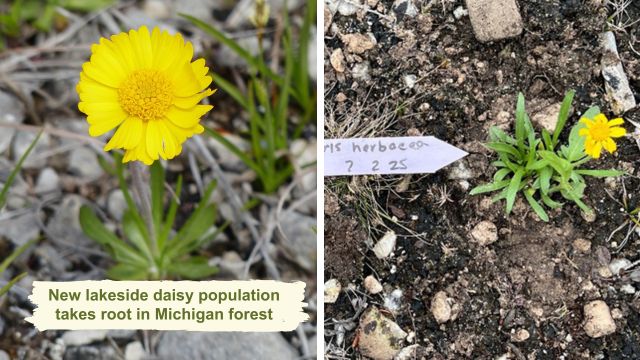
Upon first glance, this yellow flower (pictured) may not seem like anything special. To the passing eye, it may look like the common dandelion found in lawns across the United States. But earlier this spring, its story grew much bigger. This yellow daisy represents a shared vision of stewardship that took root 17 years ago with an idea to establish a new population of this federally threatened perennial forb on the Hiawatha National Forest.
The lakeside daisy (Tetraneuris herbacea) is endemic only to the Great Lakes region of the United States and Canada and requires very specific growing habitat, like alvars, gravel prairies and northern fens. In the United States, lakeside daisy is limited to few occurrences in the Marblehead Peninsula of northern Ohio, the eastern Upper Peninsula of Michigan and northern Illinois.
The vast majority (95%) of the global population occurs on Manitoulin Island and the Bruce Peninsula in Ontario, Canada, while 99% of the population in the United States occurs in the Marblehead Peninsula of northern Ohio.
Planting the seeds of a new population
In 2009, local botanists were conducting field surveys on the Hiawatha National Forest as part of a wider objective to establish a new lakeside daisy population, since existing sites were in harm’s way within roadside and utility corridors. During those surveys, they discovered suitable sites for the rare daisy, “planting” the idea for a future establishment project.
The establishment project got underway in 2020. Field staff identified the ideal place to plant them in Mackinac County, Michigan. Before this project, there were only five occurrences in Michigan, all in Mackinac County. One occurrence is a site where National Forest System and Michigan Nature Association lands meet.
A project proposal to fund the establishment of a new lakeside daisy population and aid in the recovery of the species in the Upper Peninsula was submitted to the Forest Service’s Great Lakes Restoration Initiative program in 2021. This proposal was selected for funding in 2023.
After receiving grant funding, a formal partnership was established between the Hiawatha National Forest and the Michigan Nature Association in June 2024. Because of the plants’ biologic life cycle, staff from the Michigan Nature Association couldn’t collect seeds from their sanctuary until June 2025. Once a proper window of opportunity occurred, Michigan Nature Association staff meticulously collected seeds from 50 plants and then brought them to Wildtype Native Plant Nursery in lower Michigan, where they were germinated and grown into healthy seedlings.
Partnering for recovery
Finally, and with great anticipation, in May, Hiawatha National Forest and Michigan Nature Association staff planted 70 seedlings. It was a beautiful day for many reasons; not only was the weather wonderful, but more importantly, the occasion marked the realization of an idea that had taken years to come to fruition. A resounding “we did it!” was felt amongst everyone. Not only was this a success for aiding in the recovery of a rare species, but a new partnership was developed with a group of people passionate about important ecological work.
And this is just the beginning. During the next several years, botany staff will monitor the survival of the seedlings and may augment the new population with additional seedlings or seeds.