
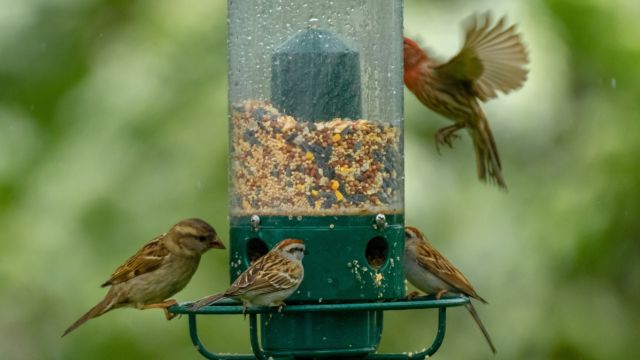
Michigan residents will once again be allowed to feed birds and other wildlife near their homes under a new law signed by Gov. Gretchen Whitmer.
The legislation, House Bill 4350, creates an exemption allowing limited backyard wildlife feeding, even in areas where the Natural Resources Commission has issued deer and elk feeding restrictions.
Residents may place feed within 300 feet of a residence as long as the total amount of feed on the ground does not exceed two gallons. The law defines wildlife feeding as providing food to prevent birds and other wildlife from starving or for recreational viewing.
The measure restores a common backyard activity that many families enjoy.
“Feeding songbirds and other backyard wildlife is a basic way to foster an appreciation for our state’s natural beauty,” Rep. Ken Borton, R-Gaylord said in a statement. “The state should never have been treating these activities as criminal acts.”
The legislation does not eliminate all restrictions related to deer feeding. The Department of Natural Resources retains authority to enforce disease-control measures where required under agreements with federal agencies, such as bovine tuberculosis and chronic wasting disease.
That distinction is especially important because deer feeding regulations already differ between Michigan’s Upper and Lower peninsulas.
The Upper Peninsula has generally allowed recreational deer feeding, while feeding and baiting have been prohibited across the Lower Peninsula since 2018 to help slow the spread of wildlife diseases. Even with the new law, the DNR has indicated that disease-management agreements could require restrictions to remain in certain areas.
Locally, the legislation is not expected to significantly change day to day practices, as recreational deer feeding has generally remained legal across the U.P.. Instead, the law clarifies that homeowners across Michigan may feed birds and other backyard wildlife near their homes under the specified limits without violating deer feeding orders.
State officials continue to encourage residents who feed wildlife to do so responsibly by keeping feeding areas clean, limiting the amount of feed placed on the ground, and avoiding practices that concentrate large numbers of deer in one location, which can increase the risk of disease transmission.