
By Tim Callahan
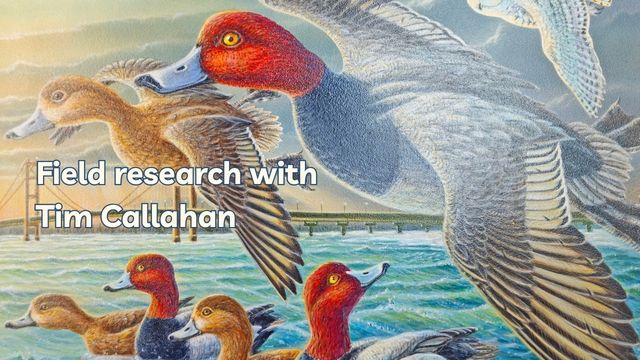
In the late fall while traveling over the Big Mac, if you glance down over the guardrail, you’ll notice thousands of diver ducks. They’re called divers for their ability to dive through deep water to feed on mussels, clams, aquatic plants, and small bait fish.
A big percentage of this flotilla of ducks are red heads; the drakes sport a bright red head, black breast, and gray back and wings. The hens have a brown head, buff beaks, and gray wings. The birds are here until ice-up, then move on down the flyway to their wintering grounds in Florida.
The term “snowbirds” likely originated from this great migration. Interestingly, the birds bypass the bridge rest stop in the spring on their way back north. They’re most likely in a hurry to get back and start a new family.
This (above) was my painting for the recent Michigan Duck Stamp Competition for the 2026 Duck Stamp. The contest was this past August at the Michigan Waterfowl Festival in Bay City. Although my entry did not win the competition, I was proud to take part in a tradition that the Michigan Department of Natural Resources (MDNR) started in 1976.
The first design was by Ozz Warbach, a MDNR staff artist, who made a woodblock print of a drake wood duck’s head and printed it in one color: Green.
Michigan, along with other popular waterfowling destinations like Minnesota and Massachusetts, have Duck Stamps patterned after the federal duck stamp program, which started in 1934 to raise funds for the waterfowl and habitat restoration. That first year, the feds printed and sold 635,000 Duck Stamps and featured a pair of mallards in flight and was designed by Ding Darling. It was Ding’s idea for the Duck Stamp! That first stamp sold for one dollar.
Today the Duck Stamp costs $25 and more than 1,500,000 are sold to waterfowlers and stamp collectors yearly. That’s a lot of bucks for the ducks!
The “big city” art critics have always frowned on nature and wildlife art, proclaiming it’s not real art, but mere illustration. Yeah, whatever! Art that represents Mother Nature—her marshes, bogs, swamps, rivers, and lakes she calls home—is also where I’m at home with my paintbrushes and canvas, knowing that my art helps wildlife and brings her a smile!