
From the CLMCD
This fall, for the first time since 2021, the Chippewa Luce Mackinac Conservation District (CLMCD) is taking part in the Deer Habitat Improvement Partnership Initiative (DHIPI). This program has been funded by the Michigan DNR for decades in an effort to benefit deer and other wildlife habitat in the Upper Peninsula. Local sportsmen groups, conservation districts, land conservancies, and other similar organizations are eligible to receive funds to do habitat improvement work on private property.
The Conservation District is working with several local landowners within Chippewa and Mackinac counties to plant trees, seed native grasses and wildflowers, and manage invasive species.
Deer habitat in the U.P. can be classified into two primary groups: summer range and winter range. Summer range is where deer disperse during the warmer months of the year, and management in this area is usually focused on providing adequate food for deer to prepare for and recover from the harsh winter months.
Food sources such as hard mast are essential to deer for surviving through the winter. Hard mast includes acorns, beech nuts, and hazelnuts. Acorns provide nutrient-dense, long-lasting food for deer in the fall and early winter and have been shown to increase deer survival and improve physical condition.
Other essential food sources for deer include soft mast and herbaceous foods. Soft mast can include things like apples, crab apples, and various fruits and berries. Herbaceous foods include certain types of grass, weeds, and other non-woody plants.
Improving access to herbaceous foods within five miles of a deer’s winter range can also help increase deer survival. It is useful to have a variety of food sources available, as different foods will be more available at certain times of the year and in different years. Acorns, for example, tend to produce bumper crops every 2-4 years.
Wintering areas for deer are an essential part of the deer life cycle in the Upper Peninsula. These areas are also known as “deer wintering complexes”. Deer wintering complexes are characterized by their ability to provide thermal cover for deer. Thermal cover is provided by tree species such as white cedar and hemlock that form dense stands and hang on to their needles all year long. These characteristics help the trees to block wind, trap heat, and intercept heavy snowfall.
Deer in the Upper Peninsula must migrate to these areas during the winter to survive, particularly during harsher winters. Therefore, it is essential to protect deer wintering complexes and provide deer with nearby food sources that they can bulk up with in the fall and refuel with in the spring.
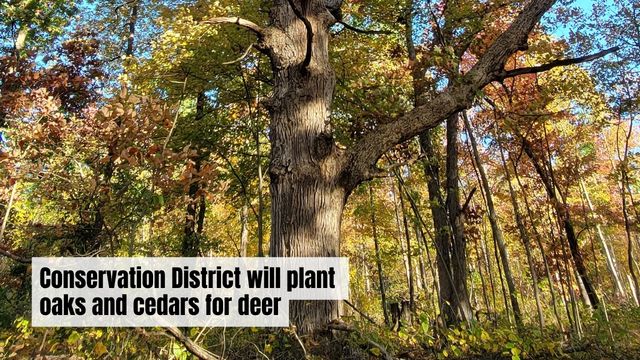
The Conservation District’s 2026 DHIPI project is focused on providing a mix of food sources for deer and thermal cover in areas close to or within deer wintering complexes. They are hoping to achieve this goal by planting a mix of trees, shrubs, native grasses, and wildflowers. Tree plantings will be red oak, white oak, American hazelnut, and white cedar.
The conservation district also wanted to focus on areas that have been impacted by past land use. Much of the area where habitat improvement work is occurring has previously been used for agriculture, including hay and Christmas tree farming. These areas are common in the Eastern U.P., and a combination of poor soils and invasive species can make it difficult for them to recover after abandonment.
This project will be completed as a collaborative effort between the Conservation District and local landowners, with assistance from the Superior Watershed Partnership and funding from the Michigan DNR. The hope is that it will provide long-lasting positive impacts to local habitats, both for deer and a variety of other wildlife.