
By Sterling McGinn
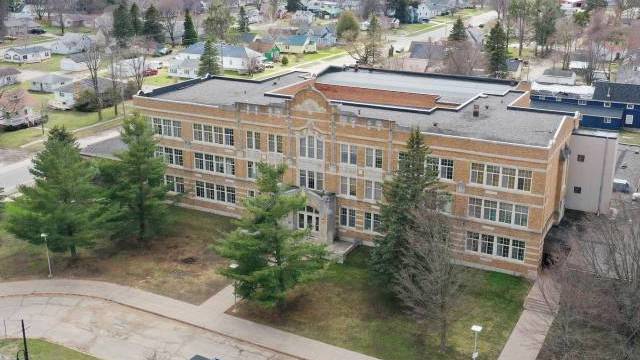
Exactly 100 years ago, the Newberry community was faced with a dilemma—where are we going to put the new high school? Residents voted to pass a bond proposal for its construction, and the high school was built where it still stands today.
Now, school officials and local stakeholders are considering saving that historic building or demolishing the school, which is now closed.
The halls are quiet. There is no heat and no one in the building. Something will need to happen.
District Superintendent Shawn Tebo, along with Career and Technical Education (CTE) teacher Linus Parr, called a meeting of interested individuals at Zellar’s Village Inn on Wednesday, February 4. Including Tebo and Parr, there were about 10 people present.
“We need to decide if we are going to continue with that building and what can we do with it, or we need to think about demolishing it,” Tebo said. “It is going to turn into a safety hazard especially with no heat in it this winter—we have already started to see it decline in the last couple of months.”
This is Tebo’s first school year with the Tahquamenon Area Schools (TAS) district. She was not here when the $9.75 million bond proposal passed in November of 2021, and she was not here during the renovation process.
The bond request included renovating the newer old middle school on the second floor of the elementary building to house grades 7-12. The three-story high school building would be “mothballed”.
The district does not have funds to renovate or demolish the old school, which has been deteriorating.
Tebo said the building is still in decent shape despite being closed for two years. Significant leaks caused damage in the old gym (later the band room) on the second floor. Those leaks were repaired, but more leaks were recently discovered.
Parr, who presented an idea to repurpose the building, has suggested using CTE funds to recondition the structure to be used for CTE and college classes.
“I believe in the preservation of the building first with proper plans put in place,” Parr said. “If that doesn’t happen, we need to come up with a contingency plan if we can’t save it.”
Tebo also has ideas for portions of the building, like using it for housing to ease the local housing shortage.
“I am an outsider looking in—this school has no memorial attachment to me,” said Tebo. “But when I first walked through it, I fell in love, and I have been through it about a dozen times.”
The current school facility doesn’t have the room for significant population growth.
“From the outside looking in, when you talk about growing the community—when a community grows, you grow students going to your school,” Tebo said. “We don’t have room for what our current bond did for our school.”
Tebo said the renovated school building does not have enough classrooms, and the district has no storage. The old high school could be the answer for more classrooms, additional storage, and more space for CTE rooms.
Talk of converting the upper levels for apartments for traveling hospital staff led to concerns regarding the building being connected to the current school building.
Parking was another issue brought up.
If the latter route was chosen, it was the consensus of the group that the school would likely have to relinquish the old high school building to another party. Relinquishing the building to a non-profit may also help with eligibility in securing grants for the building’s renovation.
Others suggested that the second-floor gymnasium, which had been converted into band/art rooms, could be again utilized, as another gym is needed in the community.
Both Tebo and Parr said that securing someone to write grants is a key step in moving forward.
“A lot of the historical preservation grants are coming due really quick,” Parr said. “A lot of them are due in the spring. There are federal grants coming out from the 250th celebration going after buildings 100 years older or more.”
No decisions were made at this meeting, however, those in attendance were interested in continuing to meet and moving forward. The group is looking to have a feasibility study as the first step.
The plan is to meet monthly. Meetings will be held in the board of education chambers in the elementary school.
“There are all kinds of ideas floating out there. I think we just need to come together as an organization if we want to move forward,” said Tebo. “There are lots of great opportunities out there.”